
Mapping the ecosystem of addiction strategy, support and service provision in Australia
An innovative resource developed by Turning Point and the Australian Institute of Health Innovation has mapped the complex and varied ecosystem of responses to alcohol and other drug (AOD) harms in Australia.
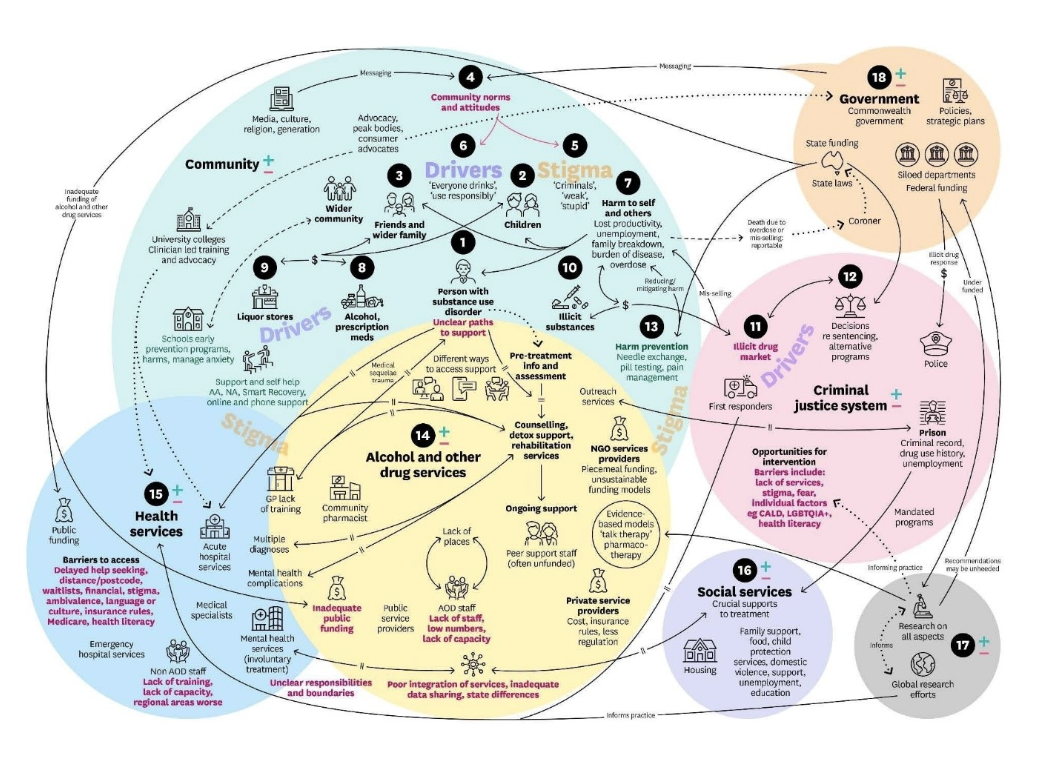
An innovative resource developed by Turning Point and the Australian Institute of Health Innovation has mapped the complex and varied ecosystem of responses to alcohol and other drug (AOD) harms in Australia. It includes responses to harms from alcohol, illicit drugs and prescription medications, such as opioids and benzodiazepines.
Shown below, the “Mapping the ecosystem of AOD responses in Australia” graphic is best interpreted in conjunction with the commentary on pages 23 to 29 of the report.
How was the resource developed?
Drawing on the concept of health care as a Complex Adaptive System, the project team captured the range of stakeholders, organisations and formal and informal services involved in the provision of treatment and support for people experiencing substance use disorders in Australia. This included mapping the broader context in which care is delivered, encompassing key issues, influences, interdependencies and barriers to accessing support.
How can the resource be used?
The work aims to inform future development of interventions by making visible the complex interplay of factors shaping AOD treatment and support – the multiple variables, interrelationships, and systems at work.
This includes highlighting siloed initiatives that are poorly integrated with other parts of the system, differences and disconnects across state boundaries, systemic cultural issues and areas of unmet need.
Access the report: Mapping the ecosystem of addiction strategy, support, and service provision in Australia: Towards better care for those harmed by addiction
Watch this webinar to learn about the development of the report and how it can be used:
Project team
Assoc Professor Janet C Long, Dr Kate Churruca, Dr Lisa Pagano, Assoc Professor Louise AEllis, Dr Samran Sheriff, Dr Tanja Schroeder, Urvi Dalal, Amielle Levy, Professor JeffreyBraithwaite and Professor Dan I Lubman.
Our funder
A philanthropic grant supported this work, and we sincerely thank the funder for their generous support.